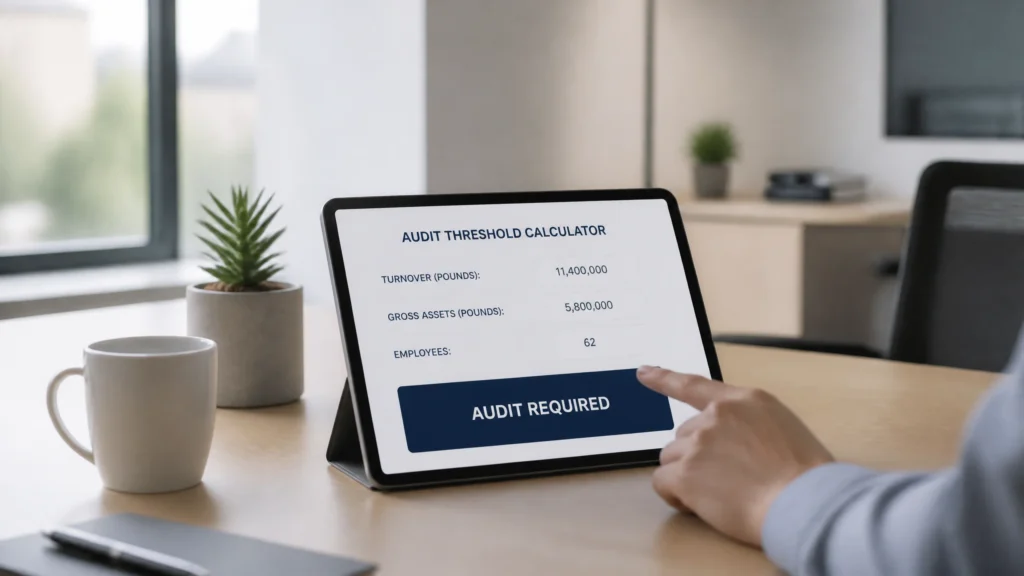
Not sure if your company needs a statutory audit? Use our free calculator to find out in 60 seconds. We’ll check your entity type, size, and whether the two-year rule applies.
What type of entity is this?
Some entities must be audited regardless of size.
What are the charity’s latest figures?
Charities above certain income and asset thresholds must have a statutory audit under the Charities Act 2011.
Enter your latest financial year figures
A company qualifies as “small” (and is exempt from audit) if it meets at least 2 of these 3 thresholds. Figures shown are for financial years beginning on or after 6 April 2025.
Does the group qualify as small?
A group is “small” if it meets 2 of 3 on a consolidated basis: turnover £15m net (£18m gross), balance sheet £7.5m net (£9m gross), 50 employees (financial years beginning on or after 6 April 2025). The worldwide group counts, not just the UK companies.
Did you also exceed these thresholds last year?
A company only loses “small” status if it exceeds the thresholds for two consecutive financial years (Companies Act 2006, Section 382).
Were you also below these thresholds last year?
A company only regains “small” status after meeting the thresholds for two consecutive years.
How the UK audit thresholds work
Under Section 477 of the Companies Act 2006, a private limited company is exempt from statutory audit if it qualifies as “small” under Section 382. For financial years beginning on or after 6 April 2025, a company qualifies where it meets at least 2 of these 3 conditions:
- Annual turnover not more than £15 million
- Balance sheet total not more than £7.5 million
- Average number of employees not more than 50
For financial years beginning from 1 January 2016 to 5 April 2025 the limits were £10.2 million turnover, £5.1 million balance sheet total and 50 employees. The test depends on when the financial year begins, not on when the accounts are filed. The calculator uses the current figures.
Crucially, a company must meet these conditions for two consecutive financial years to gain or lose small company status. A single year above the thresholds doesn’t automatically trigger an audit requirement – but it’s a strong signal to start planning.
Companies that must always be audited
Certain companies cannot claim audit exemption regardless of size (Section 478):
- Public companies (PLCs)
- Banking companies and e-money issuers
- Insurance companies (PRA-regulated)
- MiFID investment firms and UCITS management companies
- Companies with securities traded on a regulated market
- Members of a group that is not small, or is an ineligible group – unless the subsidiary exemption under Section 479A applies (which requires a UK-established parent undertaking to give a guarantee and all members to agree) or the company is dormant
Note: not all FCA-regulated firms fall into this category. A small IFA or appointed representative that doesn’t hold MiFID permissions can still claim audit exemption if it meets the size thresholds.
Charity audit thresholds
Charities follow different rules under the Charities Act 2011. A charity must have a statutory audit if:
- Gross annual income exceeds 1 million, OR
- Gross assets exceed 3.26 million AND gross income exceeds 250,000
Charities with income between 25,000 and the audit thresholds need an independent examination instead. Below 25,000, no audit or examination is required (though accounts must still be prepared). See our charity audit services page for more detail.
Need help working out your audit requirements?
If your situation is more complex – group structures, first-time thresholds, or regulatory requirements – we can review the position and give you a clear answer. Request a proposal or call us on 0161 832 4451.
Related reading
- UK Audit Thresholds and Exemptions: The Complete Guide
- Do I Need an Audit?
- Benefits of a Voluntary Audit
- How Much Does a Statutory Audit Cost?
- Audit Readiness Checklist
Related reading: Read our guide to what to expect in your first statutory audit.